Background
The rolling stock on the Skultuna layout is mainly based
on N-scale models of Swedish modern image. In
H0-scale that wouldn´t be a problem. There are a lot of
Swedish models in the market, both exclusive short
series and standard items from Märklin, Fleischmann,
Lima and Roco.
In N-scale there are just a few models available.
Fleischmanns two engines SJ Du2 and SJ RC4, a few
coaches and waggons and there is a total lack of EMU:s
and DMU:s. It makes things more difficult, but it is at
the same time the challenge that makes this type of
modelling interesting.
Most of my models are therefore scratchbuilt items.
There is quite a job to find chassis that will suite my
needs to model both engines and DMU:s. For the moment I
have used chassis from Minitrix, Fleischmann, Graham
Farish and Tomix.
The main traffic theme on the layout is regional
passenger traffic with EMU:s and the running models are
from the period around 1990,
the time when the line at Skultuna was withdrawn. On the
pictures below are my models of those EMU:s. An orange
X21, originally built in the mid 50:s and the blue and
white X10 built in the 80:s. Both types of trains are still
operating lines in mid-Sweden, though in other colours
and with other operators.


On my layout, the Skultuna line is still running and now
it´s time for some modernisation of the
rolling stock. The choice of train was rather easy
to do.
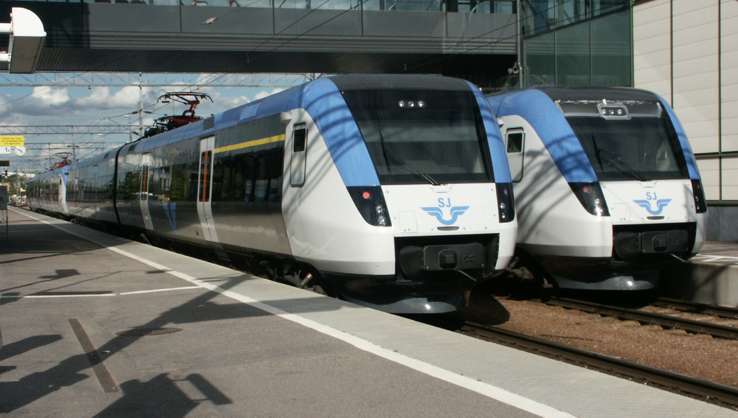
Regina class X50- X54
In the summer of 2001 Bombardier introduced the EMU Regina
on services in mid-Sweden. The trains are assembled in
Västerås, just 15 km away from Skultuna and the first
operator to run the train was "Västmanlands
Länstrafik", which is one of the the local operators in this
county.
The Reginas are made in different classes, X50 - X54 and
delivered to
SJ the
Swedish State Railways and to many local operators.
It is probably the broadest EMU in Europe. With it´s
3,4 meters it exceedes most standards.
The trains had a lot of negative attention during the
first winterperiod. There was problems with bad wheels,
frozen watertanks and stuck pantographs which forced
many of the trains to repeatedly servicestops. The
passengers could never be sure that there would be a
train at scheduled time.
The problems was corrected by Bombardier during the
spring and summer of 2002 and now the trains are well
operating.
June
2002 - Time for planning
During the summer I took a lot of photos of different
Regina units at Västerås station which is situated
just one minute´s walk from my office.
With
the
photos and some datasheets with dimensions I made a
first "mockup" made of papersheet.
It is just a preliminary sketch,
the nose is not
correct.

Challenges
The size of the unit and the specially formed nose
makes it necessarily to really think of how to make this
model.
-
To have a chance to make more than one train set I have
to figure out some way to mass-produce the nose.
-
Another problem is that the chassis is longer than the normal
chassis.
In N scale (1:160) the wheelbase would be 119mm, while
normally a long chassi is about 95 mm. You have to
extend such a chassie with 24 mm if You can´t find the
right chassis by any luck.
Chassis
Most hobby shops usually have a minimal amount of items
in stock.
Thats a pity when you are looking for chassis to adapt
to scratchbuilt bodys.
I really want to look and "squeeze" a little
before purchasing anything and that could hardly be done
by looking at pictures.
While searching for a chassis I found a second-hand
Fleiscmann unit, DB litt 612, cat.nr 7434. The wheelbase
was almost exact. But the model wasn´t good enough,
driving only on one boogie and that boogie was even
short of one cog wheel, so the driving was only on one
axle.
Passing San Francisco a couple of days in november I
made my way to Franciscan Hobbies, a quite well-stocked
shop at Ocean Avenue.
Among all other N-stuff they had not less than five
different plain chassis suitable for motor units, some
from Green Max and a couple from Kato.
The Kato 11-102 was a 20 meters chassis that was running
nice and smooth, though a little bit too short. The
price was about 30$ and with that price you could take
the risk to make some surgery to extend the lenght of
the chassis.
It is a low-built chassis, which gives
possibilitys to make a nice see-through body if
necessary. But the prototype has dark tinted windows and
in N-scale it could be enough to have black-painted
windows, but still the possibilty is there.
22
Nov 2002
Next chapter will cover the surgery that was made to
extend the chassis from 95 to 119 mm.
|


 Part 1 - Preparations
2002-12-05
Part 1 - Preparations
2002-12-05